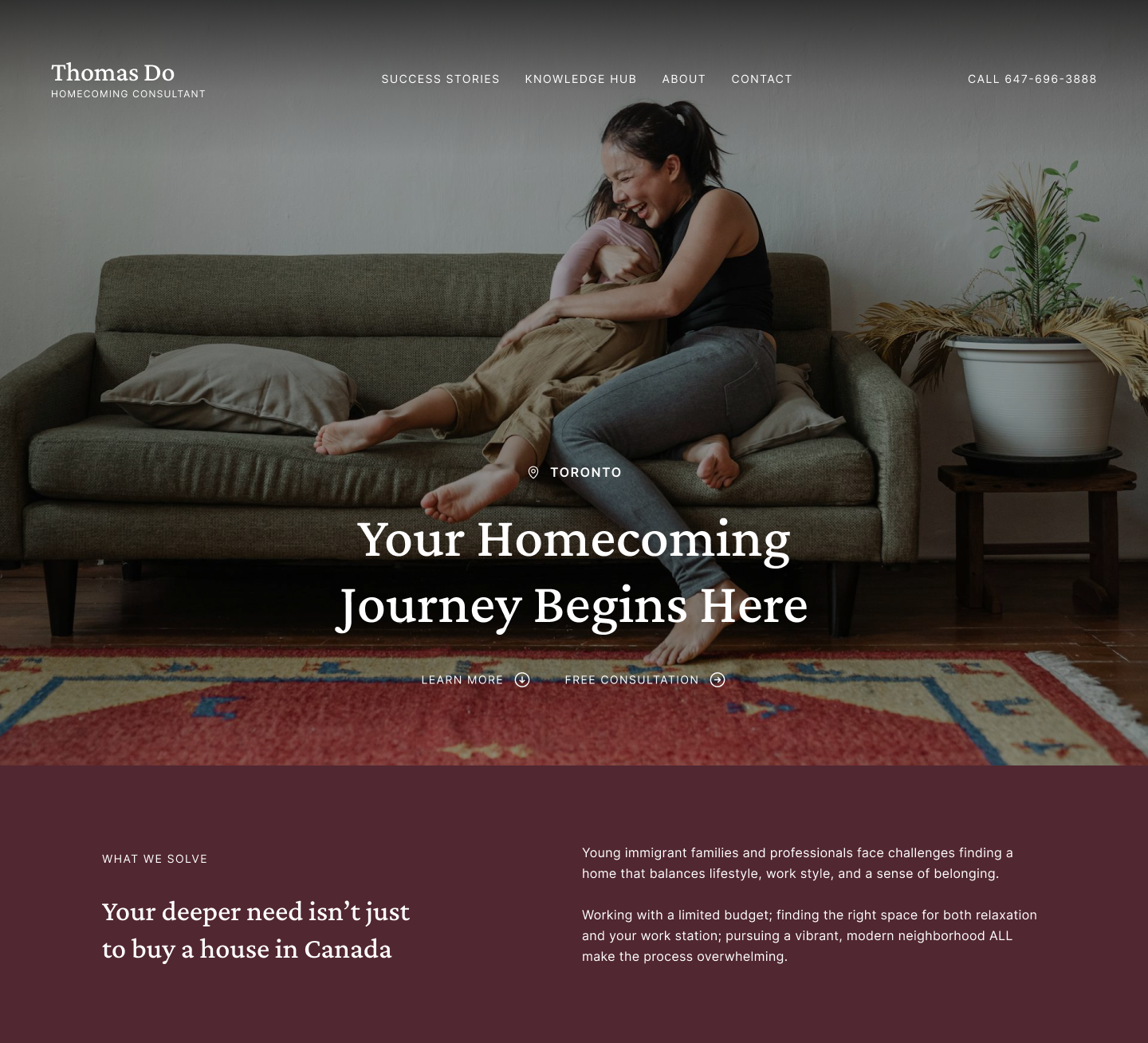
How Strategic Positioning turned a Realtor into Toronto's Immigrant Homecoming Brand
Thomas Do wasn't just another realtor in Toronto's crowded market—he was an immigrant success story waiting to become a brand. After a year of building his real estate practice, he had the expertise and authentic story, but lacked the strategic positioning to transform these assets into a distinctive brand.

Welcome to The Deep Clients. We break down the work behind brands that grow by resonating deeply, not reaching widely. Real projects. Real decisions. The principles that attract people who don't just buy from you, but invest in your vision and bring others like them.And you can build yours.Select your clients. Select your future.
How I helped a Toronto realtor stop selling houses and start guiding homecomings
Thomas had everything his ideal clients needed. Vietnamese roots. A UK education. A settlement journey in Toronto that taught him what no real estate course ever could. He understood the immigrant experience because he was living it.
But online, he looked like every other realtor. Listings. Market stats. "Let me help you find your dream home."
His most powerful asset was invisible.
The realtor's dilemma, made worse by a recession
Thomas operates in Toronto, in a market squeezed by recession. Every realtor offers the same service. The same listings. The same promises. When you compete on the same terms as everyone else, price becomes the only differentiator. And in a down market, that pressure gets brutal.
Most realtors respond by marketing harder. More listings. More open houses. More social media posts showing sold signs.
Thomas needed something different. Not more volume. A different dimension entirely.
His Vietnamese roots, his UK education, his years navigating Toronto as an immigrant, that wasn't background information. It was the foundation of something no competitor could touch.
He just couldn't see it yet.
The thing the market was missing
When I researched how young immigrant professionals approach homebuying in Toronto, I found a gap that explained a lot.
Most young immigrants focus on finding a "good house" within their budget. That's the question they ask. But underneath it is a completely different need: finding a living environment that helps them belong and thrive in a country that still feels unfamiliar.
They're not just buying property. They're trying to build a life.
Traditional realtors don't see this. They approach every client transactionally. Properties that meet financial criteria. Square footage. Commute times. Comparable sales. The mechanics are handled. The human need is ignored.
No one was asking the deeper question: where will this family actually feel at home?
I understood this gap personally. I'm Vietnamese. I came to Canada and went through my own version of that search, not just for a place to live, but for a place to belong. The difference between a house and a home isn't square footage. It's whether the neighborhood, the community, the daily rhythm of the place helps you feel like you're building something real.
Thomas understood this instinctively. He had lived it with his own family. But his brand treated it as invisible, the way most people treat their deepest knowledge. It's so obvious to them that they forget it's rare.
From selling houses to guiding homecomings
The strategic shift was clear once we could see it: Thomas isn't a realtor who happens to be an immigrant. He's an immigrant guide who happens to sell real estate.
We repositioned his entire brand around one idea: homecoming. Not "finding a property." Finding the place where your family belongs.
That meant rethinking everything.
His personal story, Vietnam to the UK to Toronto, became the foundation of the brand, not a bio page. His journey across three countries, the sense of displacement, the slow process of finding belonging, that narrative runs through everything because it's the same journey his clients are on.
The core message shifted from "I'll help you find a great home" to something his audience could feel in their chest: home isn't just where you are. It's who you're with.
The website I designed reflected this completely. No typical real estate conventions. No property-first layout. No statistics on the homepage. Instead, a storytelling canvas that follows the homecoming arc, from displacement to belonging.
Warm imagery. Earth tones that evoke arriving, not just browsing. Every page builds emotional connection before offering practical information. Client stories presented as transformation narratives, not testimonials. The experience of visiting the site should feel like meeting someone who understands your journey before you've said a word.
The deliberate trade-off: if you're a buyer who just wants the cheapest condo in the fastest closing timeline, this brand isn't for you. The warmth might feel slow. The storytelling might feel unnecessary.
But for a young immigrant family looking for someone who truly understands what "home" means when you're building a life far from where you started, Thomas becomes the only choice.
That polarization is the filter working.
None of this means the craft was loose.
Underneath the emotional warmth, every technical detail was precise:
- Site structure designed for discoverability, so immigrant families searching for guidance find Thomas through search, not just through referrals
- A content architecture that supports long-term growth, with clear pathways for neighborhood guides, homecoming stories, and lifestyle content
- Clean responsiveness across every device
- SEO foundations built around the real questions immigrant homebuyers ask, not generic real estate keywords
The strategy only works if the execution is invisible. A visitor should feel understood, not designed at.
A strategy that keeps generating
The homecoming positioning didn't just create a website. It created a foundation that makes content natural instead of forced.
Instead of standard property tours, Thomas can create lifestyle-first reviews showing how spaces support the way real families live. Instead of market updates, he can share neighborhood cultural intelligence, helping immigrants find communities where they'll actually thrive. Instead of testimonials, he can tell homecoming stories, conversations with families about how their lives changed when they found the right environment.
Every piece of content reinforces the same position: Thomas is the guide who understands the journey because he's lived it.
That's sustainable differentiation. Not a marketing angle that expires. A truth that deepens over time.
What changed
Thomas transformed from a realtor competing on the same terms as everyone else into someone who owns a position no competitor can replicate.
His brand now attracts clients who resonate with his story and values before the first conversation. They arrive already trusting him, not because of his sales numbers, but because his presence communicates something they've been looking for: someone who gets it.
In a recession market where every other realtor is fighting for attention with louder marketing, Thomas is doing the opposite. Speaking to fewer people. Resonating with the right ones. Building relationships that don't depend on market conditions.
His differentiation can't be copied. It's rooted in his life.
What this project is really about
A realtor with a powerful immigrant story was competing on the same terms as everyone else. His deepest knowledge, the thing that made him irreplaceable to the right client, was invisible online.
I helped him see that his life was his positioning. And then I built the systems that made it visible to the families who needed exactly what he offered.
This is what I do. Not websites. Not design.
I show you what you can't see from inside. And then I build something that makes the right people feel they've found their place.
If something in this story felt familiar, if you know your experience runs deeper than your online presence shows, I'd love to have a conversation.
Not a sales pitch. A real conversation about your business, your presence, and where your website might be quietly hiding the very thing that makes you valuable.
You don't need to look like everyone else. You need to look like yourself, clearly enough that the right people recognize it.
They're out there. They're looking for someone who sees things the way you do.
Your website just needs to help them find you.
— From Hieu Vu
The Transformation
Attracting premium clients who value quality over cost